DIY Terrarium: The Science of Building a Self-Sustaining Closed Ecosystem
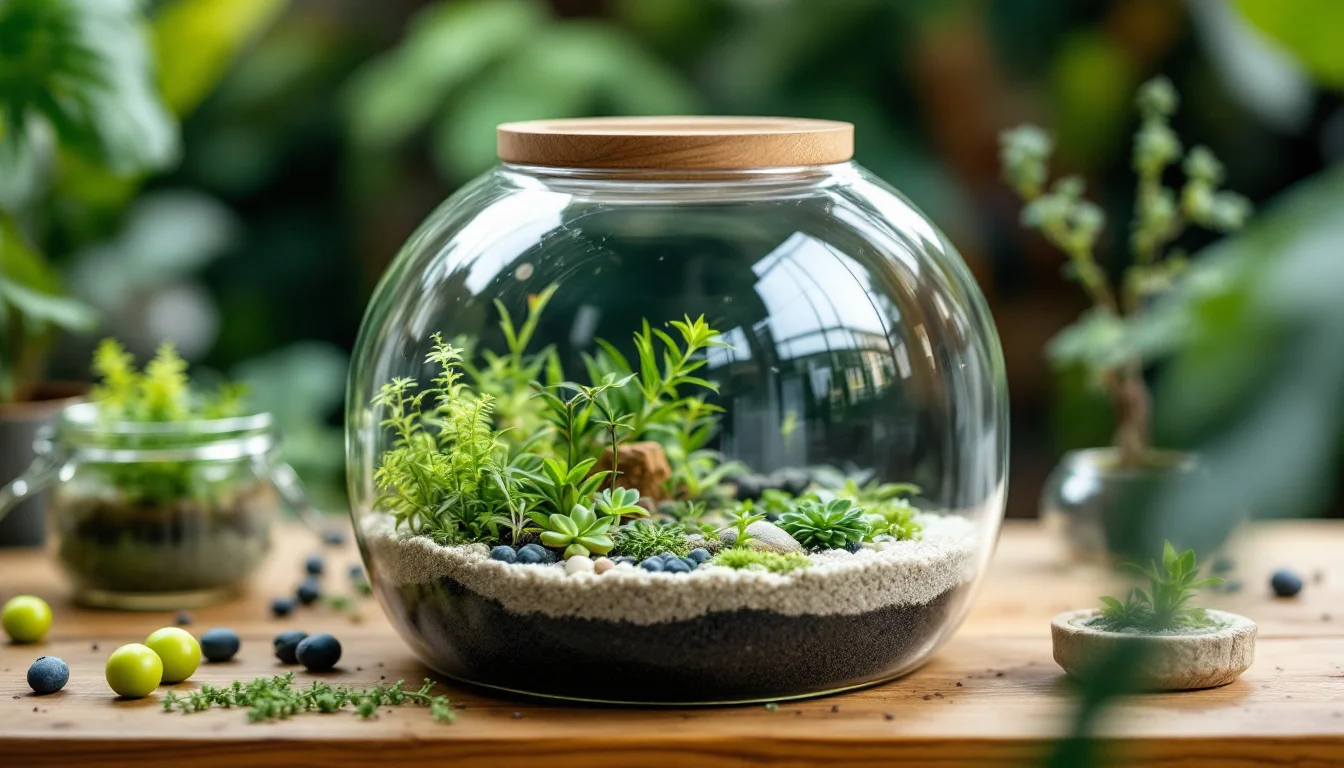
Key Takeaways
- A closed terrarium recycles its own water through an internal condensation loop.
- LECA requires less depth and adds less weight than pea gravel for drainage.
- A mesh barrier outlasts sphagnum moss in separating internal layers.
- Springtails control mold, which is widely cited as the most common closed-terrarium issue.
- An over-saturated jar shows condensation on all sides and requires venting.
David Latimer's renowned terrarium is frequently cited as an example of extreme terrarium longevity. However, because he never tried to physically control or prune the enclosure over those decades, it is a wild bottle garden rather than a curated landscape.
Building a modern closed terrarium is more about micro-ecosystem engineering than standard gardening. Success in a sealed environment requires executing precise substrate layering, observing biomass limits, and utilizing the deployment of microfauna. These foundational principles act in concert to prevent the closed system from stagnating, souring, and rotting.
How the 'Science of the Seal' Works
The engine driving this self-contained world is the internal water cycle, a mechanism documented by House Plus Plant. In a standard potted plant setup, excess moisture escapes into the room. In a closed ecosystem, water added to the terrarium has nowhere else to go. As ambient temperatures fluctuate throughout the day, moisture evaporates directly into the air inside the sealed container, raising the internal humidity.
When the temperature cools, this dense, humid air can no longer hold the same volume of water. The vapor condenses on the cooler glass walls of the enclosure. As the droplets combine and grow heavier, gravity takes over, and the water falls back down as miniature "rain" to water the plants and replenish the substrate. This autonomous physical loop means the ecosystem constantly recycles its available resources.
Yet, a well-built, self-sustaining terrarium will never stay frozen in time. Leaves will drop, roots will expand, and fungal networks will continuously shift. According to Terrarium Tribe, the objective is to establish a balanced baseline where the rates of plant growth, water cycling, and organic decay sustain each other over the long haul.
Engineering the Foundation: Drainage, Separation, and Substrate
The False Bottom Drainage Comparison
The base structural layer, often called a "false bottom," often determines long-term success. A base layer of either pea gravel or clay pebbles is needed so that excess water can safely sit at the bottom of the terrarium until the plants need it, rather than remaining trapped around delicate root systems.
When engineering this reservoir, Terrarium Tribe notes that LECA clay pebbles are better than standard gravel for the drainage layer. The recommended thickness of the drainage layer depends on the chosen material:
| Drainage Material | Required Depth | Weight Added to Glass | Compaction Risk |
|---|---|---|---|
| Pea Gravel | 2 to 3 inches | High | Moderate |
| LECA | 1 inch | Low | None |
The Separation Barrier
Directly above the false bottom, a barrier or separation layer must sit between the drainage material and the substrate to keep the distinct layers from mixing over time. Either a fine mesh barrier or a thin layer of long-fibre sphagnum moss is typically employed. Mesh is preferred because it holds its structure indefinitely and does not decompose. In contrast, organic sphagnum slowly breaks down as the system matures, eventually threatening the structural separation.
Substrate Chemistry and Filtration
The growing medium dictates the ecosystem's chemical balance. The substrate used should always be a dedicated terrarium substrate engineered for good drainage and water retention, rather than ordinary potting soil. For a budget-friendly approach, House Plus Plant recommends a mix for a closed terrarium of equal parts sand, sphagnum moss, and potting soil. This creates a rich, well-draining substrate suitable for standard humidity.
However, standard potting soils are susceptible to sudden mold outbreaks when sealed. A bioactive mix avoids ordinary potting soil entirely, instead utilizing materials that support microfauna and active microbial life. Blends relying on earthworm castings offer safe organic nutrition, alongside specialized aggregates to prevent anaerobic zones.
To further protect the ecosystem, activated charcoal is an optional addition. It can sit directly above the mesh as a distinct black layer or be evenly sprinkled throughout the substrate layers. In a closed environment, charcoal helps adsorb impurities and toxic organic compounds as water cycles downward through the substrate. This chemical filtration adds a buffer against stagnation and odor, though it is not a substitute for establishing good physical drainage structure.
Biomass and Microfauna: Populating the Ecosystem
Selecting the Right Botanical Biomass
Because the glass container restricts physical expansion, biomass limits must be respected. Dwarf varieties and carefully curated miniature terrarium plants are recommended by Terrarium Tribe because they will not outgrow the container, even when they reach mature sizes.
Choosing the botanical species determines the visual and biological balance of the enclosure. Recommended plants tailored for long-term balance include Biophytum sensitivum (commonly known as the Little Tree Plant), which serves as a central foliage plant. For ground cover, Pilea glauca 'Aquamarine' works well as a delicate trailing plant. To complete the canopy, Nephrolepis cordifolia 'Duffii' (the Lemon Button Fern) provides a resilient fern structure that thrives in dense humidity.
The Microfauna Cleanup Crew
To prevent the shedding of organic matter from collapsing the ecosystem, live detritivores must be introduced. Springtails are a reliable way to keep a self-contained terrarium chemically clean and physically healthy over time. These tiny hexapods naturally thrive in extreme humidity, require virtually no supplemental care, and feed on mold, which Terrarium Tribe cites as the number one closed-terrarium issue. A 16 oz culture of springtails is considered enough to seed a handful of small terrariums or one large terrarium.
Isopods offer an additional layer of biological processing. They are efficient scavengers that can rapidly break down fallen leaves and heavier organic debris, effectively converting solid waste into bio-available nutrients for the plant roots. However, they add notable complexity to the system's oxygen and food demands. The more animals introduced to the glass, the more management the system may require to prevent population crashes.
Step-by-Step Assembly Guide
Executing the build correctly requires assembling the engineered components in chronological order to ensure the internal water cycle functions smoothly. The quick-overview closed terrarium build sequence is:
- Choose a clear glass container equipped with a lid. It does not need to be airtight, but it should retain humidity reliably over the long term.
- Add a structural drainage layer of LECA clay balls, pouring them gently until they sit about 1 inch deep at the base of the glass.
- Separate the LECA drainage and the upcoming substrate with a physical barrier of fine mesh or a thin layer of long-fibre sphagnum moss.
- Add a specialized tropical substrate mix that holds adequate moisture but remains airy enough to prevent root suffocation.
- Carefully plant compact, humidity-loving species, leaving sufficient physical space between their root zones to minimize competition.
- Lightly moisten the newly laid substrate until it feels uniformly damp, checking the base to ensure it is not saturated.
- Seal the container tightly with its lid and let the newly assembled system settle.
Diagnosing Moisture and Mold: The First 30 Days
The first thirty days following the final seal are the most volatile phase of the terrarium's lifecycle. As the plants undergo transplant shock and the internal water cycle struggles to find equilibrium, the ecosystem relies on precise moisture management. The internal health of the enclosure can be diagnosed without opening it, simply by studying the water patterns on the glass.
Under optimal biological conditions, light condensation should periodically appear on the glass. This moderate fogging indicates a healthy thermal gradient, proving that water is evaporating and condensing at a sustainable rate.
Conversely, if condensation is present on all sides continuously, the system is over-saturated. In this scenario, the jar should be opened and left to sit for a few days to a full week. This crucial venting period lets some excess moisture out, preventing the fungal blooms that thrive in stagnant, waterlogged environments.
FAQ on Closed Terrarium Engineering
Can ordinary potting soil be used as the main substrate?
Standard potting soils are highly susceptible to sudden mold outbreaks when sealed inside a terrarium. It is recommended to use a dedicated terrarium substrate engineered for good drainage, or a budget-friendly blend containing equal parts sand, sphagnum moss, and potting soil to create a well-draining environment.How do I know if the terrarium is over-watered?
Condensation patterns on the glass reveal internal moisture levels. If condensation coats all sides of the glass continuously, the ecosystem is over-saturated. Venting the jar by opening the lid for a few days to a week will release excess humidity and help re-establish a balanced water cycle.Conclusion
Building a functional closed terrarium is an exercise in biological patience and micro-engineering. As the carefully curated plants mature and establish a localized equilibrium, the ultimate test becomes stability over permanence. Rather than remaining a static display, a successful ecosystem will shift as fungal networks expand and detritivores like springtails manage decay. With the proper foundation and biomass limits, the enclosure transforms into a remarkably resilient, self-governing world that requires minimal human intervention over the decades.